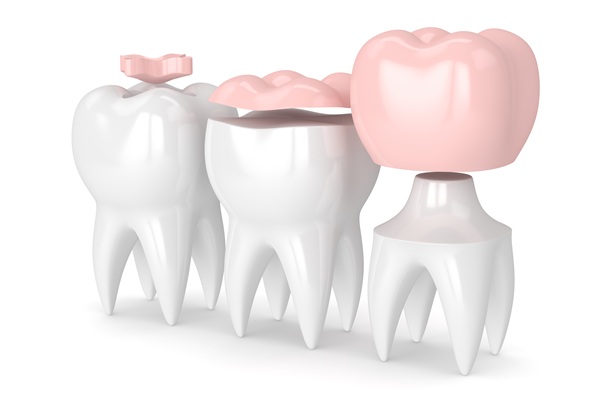
A dental inlay is one of several restorative options available to repair damaged teeth and preserve oral health. When decay, fractures, or wear compromise the strength or structure of a tooth, dentists consider the severity and location of the damage to determine the most appropriate treatment. Understanding the differences between a dental inlay, onlay, filling, and crown helps patients make informed decisions about their care and long-term results.
When to consider restorative dentistry
Teeth weakened by decay or trauma may require more than a simple repair. Restorative dentistry focuses on rebuilding the tooth structure, preserving healthy tissue, and preventing further complications. The right treatment depends on how much of the tooth remains intact and whether the damage extends beyond the surface.
Dentists evaluate several factors, including bite pressure, location of the tooth, cosmetic goals, and how the damage affects surrounding structures. Each option—filling, inlay, onlay, or crown—offers unique advantages.
Dental fillings: a common first step
Dental fillings help treat minor to moderate cavities. After removing the decayed portion of the tooth, the dentist fills the space with composite resin or amalgam. This solution is quick and cost-effective, especially for small areas of decay.
Fillings are ideal when the remaining tooth structure is healthy and strong. However, they may not provide sufficient support when a significant portion of the tooth is compromised. In these cases, more advanced restorations, such as inlays or onlays, are considered.
Dental inlay: a precise fit for moderate damage
A dental inlay fits within the cusps of the tooth—the raised points on the biting surface—and is custom-made to match the exact shape of the damaged area. Inlays are stronger than traditional fillings and provide a durable, long-lasting solution for moderate decay that does not affect the outer edges of the tooth.
Made from porcelain, ceramic, or composite resin, inlays are bonded securely into place, offering a seamless appearance and improved structural integrity. Dentists often recommend a dental inlay when the damage is too extensive for a filling but does not yet require the full coverage of a crown.
Dental onlay: covering more surface area
A dental onlay is similar to an inlay but extends beyond the inner surface to cover one or more cusps of the tooth. Onlays are sometimes referred to as partial crowns because they restore a larger area while preserving more of the natural tooth compared to a full crown.
This option is ideal when damage affects both the center and outer surface of the tooth, but the root and the majority of the structure remain strong. Dental onlays offer excellent durability and aesthetics, especially when made with tooth-colored materials.
Dental crowns: full coverage for severe damage
Dental crowns are a common treatment when a tooth has lost most of its structure due to decay, fracture, or prior restorations. A crown fully covers the visible portion of the tooth and protects it from further damage. This restoration is often common after root canal therapy, severe cracks, or for structurally unsound teeth.
Crowns can consist of ceramic, porcelain-fused-to-metal, or zirconia, depending on the location and functional demands. A crown offers the highest level of strength and is essential when the preservation of the natural tooth depends on complete reinforcement.
Comparing the Options
Each restorative treatment serves a specific purpose, and selecting the best one depends on a clinical evaluation. A general or cosmetic dentist considers factors such as:
- Size and location of the damage
- Health of the surrounding tooth structure
- Patient’s bite and functional needs
- Long-term durability and aesthetics
A dental inlay or onlay may be the preferred option when a filling is not strong enough, but a crown would remove too much healthy tissue. This conservative approach helps maintain the integrity of the tooth while providing lasting protection.
Preserving natural teeth with precision treatment
The goal of restorative dentistry is to maintain as much of the natural tooth as possible while ensuring function, appearance, and long-term health. Each solution—from a simple filling to a full crown—plays a role in that process.
A dental inlay, onlay, filling, or crown offers a tailored solution based on individual needs. Accurate diagnosis and thoughtful treatment planning ensure that the chosen restoration supports oral health, resists future damage, and contributes to a confident smile.
Learn more today
Regular exams and imaging help identify issues early, allowing for more conservative treatments whenever possible. With professional guidance and ongoing care, patients can restore their teeth effectively and protect them for years to come. For more information or to schedule an appointment, call our office at (770) 800-0178.
To schedule a consultation, request an appointment on our website at https://www.lilburnfamilydentistry.com or call Lilburn Family Dentistry at (770) 800-0178 for an appointment in our Lilburn office.
Check out what others are saying about our services on Yelp: Dental Inlay in Lilburn, GA.
Recent Posts
Acting quickly by consulting an emergency dentist when facing the signs of dental implant rejection helps to protect the jawbone and surrounding teeth. While implants offer a permanent, high-success solution for missing teeth, the body occasionally struggles to integrate the titanium post with the natural bone. This complication requires immediate attention to halt the spread…
Are you considering a smile makeover? Read on to learn more. A smile makeover has both cosmetic and emotional value. The psychological effects extend to one’s self-esteem and self-image. According to the American Academy of Cosmetic Dentistry, nearly 99.7% of individuals consider a smile an important social asset. Smiles have a high social value, and…
A smile makeover is a treatment plan designed to enhance a patient’s smile through various procedures. Two of the most common are dental veneers and dental crowns. Which one of these treatments a dental professional may recommend will depend on the condition of the patient's teeth, including health and appearance, and their goals for their…
Most people develop a cavity at some point in their lives, but children are especially prone to tooth decay. Dental sealants can be used to help lower the risk of getting cavities, protecting a child's teeth for many years. This supplemental treatment offers many benefits and is recommended by most dentists for virtually all children…